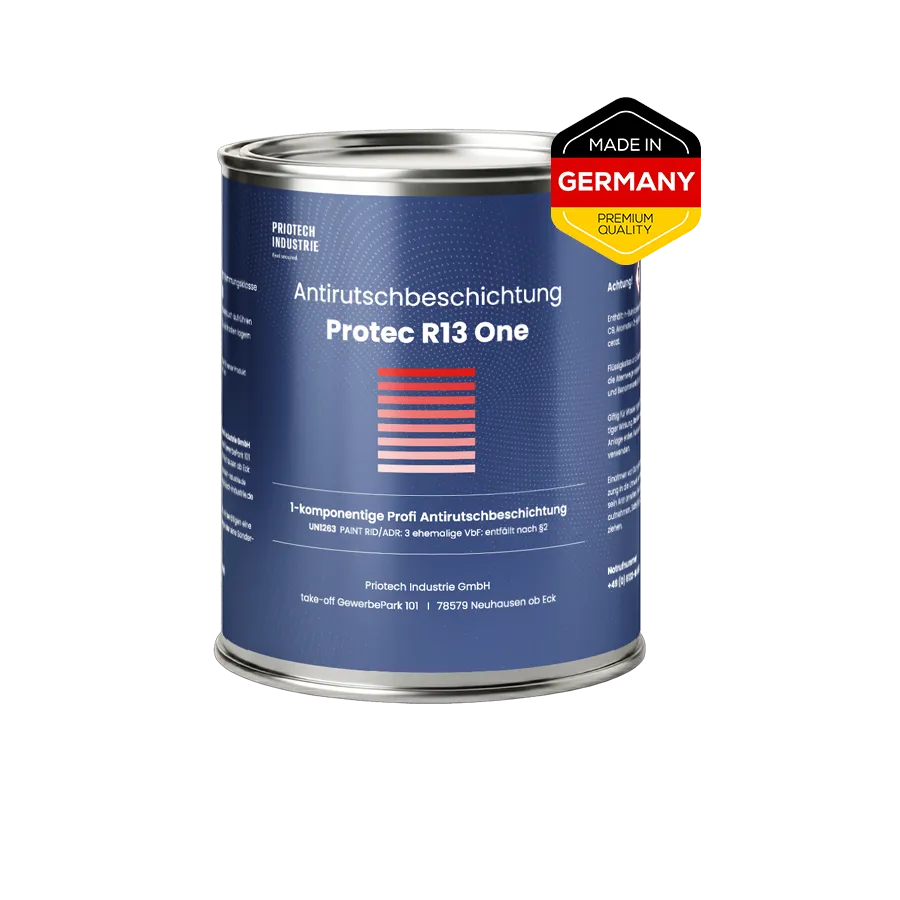
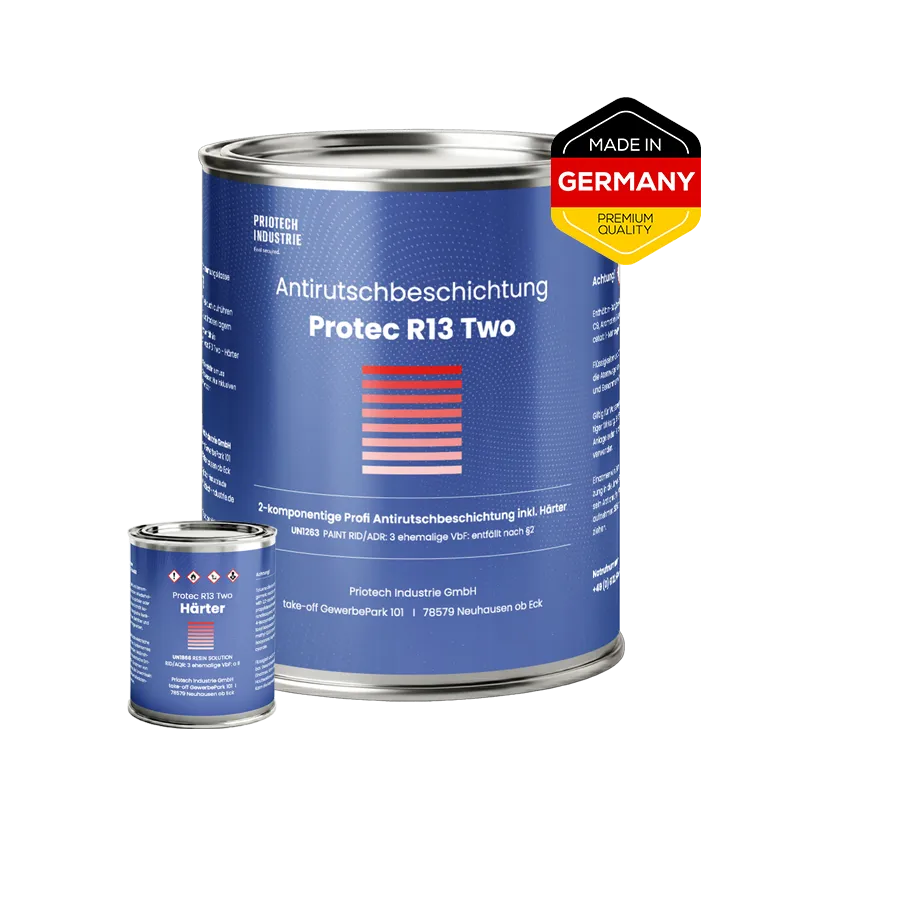
The perfect anti-slip coatings for concrete

How can concrete floors be made slip-resistant?

To secure concrete floors against slipping, various measures can be taken:

Non-slip coatings: Use special non-slip sealants or coatings that are applied to the concrete. These increase the surface roughness.

Surface treatment: Mechanical processes such as grinding or sandblasting can change the surface structure and increase slip resistance.

Anti-slip agents: There are special products that can be added to the concrete surface to improve slip resistance.

Wire mesh or mats: In areas with a high risk of slipping, non-slip mats or wire mesh can be installed.

Regular cleaning: Keep the floor clean and free of contaminants such as oil, water, or dirt, which can increase the risk of slipping.

Marking of hazard zones: Use conspicuous markings to identify dangerous areas and draw attention to potential slip hazards.

These measures can help to significantly improve safety on concrete floors.

Which anti-slip coatings are best suited for concrete surfaces?

Anti-slip concrete from Priotech Industrie - the best solution.

There are various anti-slip coatings suitable for concrete surfaces. Here are some of the most common types.

Polyurethane coatings

Properties: High flexibility and abrasion resistance. They are chemical-resistant and offer good slip resistance.
Application: Ideal for indoor and outdoor areas, e.g., in garages, storage rooms, and on terraces.

Epoxy resin coatings

Properties: Very robust and durable. They offer excellent adhesion and are available in various slip resistance grades.
Application: Frequently used in industrial and commercial environments.

Acrylic coatings: Properties: Fast-drying and easy to apply. They offer good slip resistance and are available in various colors.
Application: Good for interior spaces and outdoor surfaces subject to less stress.

Anti-slip additives:

Properties: These can be added to existing coatings to increase slip resistance. They are available in the form of quartz or corundum particles.
Application: Suitable for all types of concrete surfaces that are already coated.

Silicone coatings

Properties: Provide a flexible, anti-slip surface that is also water-repellent.
Application: Ideal for outdoor areas where moisture is a concern.

When choosing the right anti-slip coating, it is important to consider the specific requirements of the environment, such as the expected load, weather conditions, and desired aesthetics.

Where is the anti-slip coating from Priotech Industrie applied on concrete?

Anti-slip coatings on concrete are used in a variety of applications to increase safety and minimize the risk of slipping. Here are some typical areas of use.

Industrial facilities: In factories and warehouses, where heavy machinery and vehicles are frequently used, to ensure that employees do not slip on the floors.

Commercial kitchens: In restaurants and catering businesses, where water and other liquids can get on the floor.

Parking garages: On parking areas and ramps to ensure the safety of vehicles and pedestrians.

Stairs and platforms: In public buildings, residential complexes, and industrial plants to prevent falls on stairs and elevated surfaces.

Balconies and terraces: In residential and commercial applications to increase slip resistance in wet weather conditions.

Garages: In private and commercial garages to improve safety when parking and moving within the space.

These applications illustrate how important anti-slip coatings are for ensuring safety on concrete surfaces in various environments.

How can you recognize a high-quality anti-slip coating?

A good anti-slip coating can be identified by several features. Here are some important points you should look out for.

Slip resistance rating Pay attention to the slip resistance rating (e.g., R9 to R13 according to DIN 51130). The higher the value, the more slip-resistant the coating is.

Material quality High-quality anti-slip coatings consist of robust, durable materials that are resistant to wear and chemical influences.

Ease of application A good coating should be easy to apply, either by yourself or by professionals. Check whether clear instructions for application are provided.

Drying time Find out about the drying time of the coating. A fast drying time can make it easier to use.

Water and dirt repellent A good anti-slip coating should also be water and dirt repellent in order to promote hygiene and longevity.

UV resistance If the tiles are in an area with sunlight, the coating should be UV-resistant to prevent fading or embrittlement.

Durability Find out about the service life of the coating and whether it needs to be renewed regularly.

Certifications and tests Look for products that have been tested and certified by independent institutes. This gives you additional security regarding the quality.

What makes the anti-slip coating from Priotech Industrie particularly suitable for use on concrete?

Priotech Industrie's anti-slip coatings are particularly suitable for application on concrete for several reasons:

High-quality materials: Priotech uses advanced materials that offer high resistance to wear and chemical influences. This makes the coatings durable and ideal for high-traffic areas.

Slip resistance: The special formulations of the coatings provide excellent slip resistance that can be adapted to different requirements, whether for dry or wet conditions.

Versatility: Priotech anti-slip coatings are suitable for a variety of applications, both indoors and outdoors. They can be applied to various concrete surfaces, including industrial and commercial environments.

Easy application: The products are easy to process and can be applied in several layers to achieve the desired slip resistance.

UV resistance: Many of the Priotech coatings are UV-resistant, which means they retain their properties and do not fade even when exposed to direct sunlight.

Aesthetic options: Priotech offers a range of colors and surface textures that allow the coating to be adapted to the design and requirements of the respective room.

These properties make Priotech's anti-slip coatings an excellent choice for improving the slip resistance of concrete surfaces in various applications.

Use Cases

Our anti-slip coating is used in private, commercial, and industrial settings.

  • Concrete floors

    Floors in warehouses, production facilities, machine halls

  • Balconies

    Balconies, terraces, forecourts etc.

  • Stairs

    Concrete stairs, paths, and ramps, in particular basement stairs & entrances

  • Parking garages

    Parking spaces and parking areas in parking garages

1 of 4

How must concrete floors be prepared for an anti-slip coating?

Preparing concrete floors for an anti-slip coating is crucial for the adhesion and long-term effectiveness of the coating. Here are the steps for proper preparation.

Cleaning:
The concrete floor must be thoroughly cleaned to remove dirt, oil, grease, dust, and other contaminants. This can be done by sweeping, mopping, and, if necessary, using high-pressure cleaners or special cleaning agents.

Drying:
The floor must be completely dry before a coating is applied. Check that no moisture is trapped in the concrete, as this can impair adhesion.

Surface inspection:
Check the floor for cracks, holes, or other damage. These should be repaired to ensure an even coating.

Grinding or abrading:
To increase surface roughness and improve coating adhesion, it may be necessary to grind or abrade the surface. This also removes old coatings that could impair adhesion.

Dust removal:
After grinding, the floor should be thoroughly dusted again to ensure that no dust particles impair the adhesion of the new coating.

Checking pH levels:
When using special coatings, it may be important to check the pH level of the concrete. A pH level that is too high can impair the adhesion of the coating.

Priming:
In many cases, it is advisable to apply a primer to improve the adhesion of the anti-slip coating. This should be selected and applied according to the manufacturer's instructions.

This careful preparation ensures that the anti-slip coating adheres optimally and maintains its effectiveness over a longer period of time.

At what temperatures should the coating be applied?

The optimal temperature for applying an anti-slip coating to tiles varies depending on the product, but as a general rule, the following temperature conditions should be observed:

Room temperature: Ideally, application should take place at temperatures between 15 °C and 25 °C. This ensures good adhesion and drying of the coating.

Avoiding extreme temperatures: Avoid application at extremely high or low temperatures, as this can impair the properties of the coating. Excessively high temperatures can shorten the drying time and lead to uneven application, while excessively low temperatures can delay curing.

Avoiding humidity: Ensure that the air humidity is not too high, as this can also affect drying time and adhesion. A relative humidity of 40-60% is ideal.

Substrate temperature: Ensure that the tile surface is also within the recommended temperature range to guarantee optimal adhesion.

It is important to follow the specific instructions provided by the anti-slip coating manufacturer, as these should contain precise recommendations for the application temperature.

How long does it take for an anti-slip coating on concrete to dry?

The drying time of an anti-slip coating on concrete floors can vary depending on the product, ambient conditions, and application. In general, the following guidelines apply.

Touch-dry: Many anti-slip coatings are touch-dry after about 1 to 2 hours. This means the surface is no longer tacky but has not yet fully cured.

Curing: Full curing can take anywhere from 24 hours to several days, depending on the type of coating and ambient conditions (such as temperature and humidity).  

Manufacturer's instructions: It is important to follow the specific instructions provided by the manufacturer, as these contain the most accurate information regarding drying and curing times for the respective product.

Floor loading: As a rule, the coated floor should not be walked on or subjected to loads during the curing period in order to achieve optimal results.

To ensure the best results, ambient conditions should be monitored constantly during application and drying.

How long does an anti-slip coating last on concrete?

The durability of an anti-slip coating on concrete floors can depend on various factors, including the type of coating, the usage of the area, environmental conditions, and maintenance. In general, the following applies:

Type of coating: Epoxy resin coatings can generally last 5 to 10 years, depending on the level of wear. Polyurethane coatings are often even more durable and can last up to 10 years or more. Acrylic coatings generally have a shorter lifespan of about 2 to 5 years.

Usage and wear: In high-traffic areas, such as industrial facilities or commercial kitchens, the lifespan may be shorter, while the coating may last longer in less demanding areas.

Environmental conditions: Factors such as temperature, humidity, and UV exposure can affect durability. Coatings in outdoor areas are often exposed to harsher weather conditions, which can shorten their lifespan.

Care and maintenance: Regular cleaning and maintenance can extend the lifespan of the coating. Preventing contamination and repairing damage in a timely manner are also important.

Installation: Proper preparation and application of the coating are crucial for its durability. Errors during application can significantly reduce its lifespan.

In summary, the durability of an anti-slip coating on concrete floors can vary depending on the factors mentioned, but with the right selection and care, long-term performance is possible.

How do you clean concrete floors that have an anti-slip coating?

Cleaning concrete floors with an anti-slip coating should be done carefully to maintain the integrity of the coating. Here are some recommended steps for cleaning.

Regular cleaning: Sweep the floor regularly to remove dust, dirt, and loose particles. A broom or vacuum cleaner can be used for this.

Mopping: Use a damp mop or a floor wiper with warm water to mop the floor. Be sure not to use too much water to minimize the risk of slipping.

Cleaning agents: If necessary, use mild, pH-neutral cleaning agents suitable for coated floors. Avoid harsh chemicals or abrasive cleaners, as these can damage the anti-slip coating.

Stain removal: For stubborn stains, special cleaners or a diluted solution of vinegar or baking soda can be used. Test the product on an inconspicuous area first to ensure it does not damage the coating.

Rinsing: After using cleaning agents, the floor should be rinsed thoroughly with clear water to remove any residue.

Drying: Allow the floor to dry well after cleaning to minimize the risk of slipping and keep the surface in good condition.

Preventing dirt accumulation: Use mats at entrances to reduce the ingress of dirt and moisture.

By following these cleaning guidelines, you can extend the lifespan of the anti-slip coating on your concrete floor and increase safety.

Can an anti-slip coating on concrete be repaired afterwards?

Yes, it is possible to repair an anti-slip coating on concrete floors retrospectively. Here are the steps you can follow to do so.

Inspection: Check the coated area for wear, cracks, or damage to determine which areas need to be repaired.

Cleaning: Clean the affected areas thoroughly to remove dirt, dust, and residue. Use a broom, a vacuum cleaner, or a damp mop for this purpose.

Sanding: For heavily worn or damaged areas, it may be necessary to lightly sand the surface to improve the adhesion of the new coating.

Repair: If there are cracks or holes, these should be filled with a suitable repair material for concrete. Allow the repair to dry completely.

Priming: In some cases, a primer may be required to ensure better adhesion of the new anti-slip coating. This depends on the type of coating used.

Applying the new coating: Apply the anti-slip coating to the repaired areas according to the manufacturer's instructions. Make sure to apply the coating evenly and at the correct layer thickness.

Drying time: Allow the new coating to dry and cure according to the manufacturer's instructions before walking on or subjecting the area to load again.

Further application examples

  • Garages

    Garages, underground garages, stairwells and garage entrances

  • Ramps

    Corridors and ramps specifically for people with disabilities

  • Terraces

    Paths and patios made of concrete or concrete slabs

1 of 3

Talk to us

We are here for your request. Do you have any questions or would you like a quote for a larger quantity?

What would you like to tell us?

We will contact you as soon as possible.