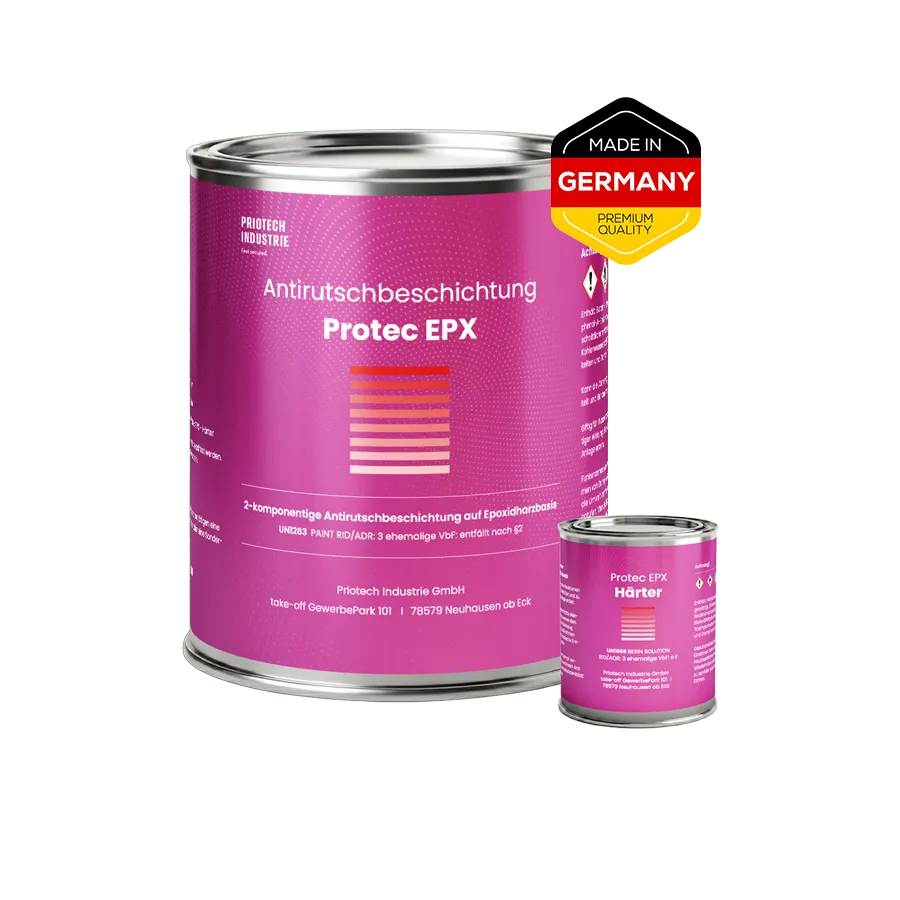
Developed at customer request: Protec R13 EPX - Specially for wind turbines, shipbuilding, and offshore

Some time ago, the operator of a large wind farm contacted us and asked for an anti-slip coating for the toughest requirements. It had to be an epoxy resin-based anti-slip coating that would optimally combine the highest anti-slip class R13 with ease of application, maximum resistance to chemical and mechanical stress, and durability.

Anti-slip Offshore & Wind Power by Priotech Industrie

In short, we developed this coating and our customer has been using our special product with great satisfaction. Are you also a wind farm operator, or do you need a reliable anti-slip coating for the offshore sector? Then you should definitely try our product Protec R13 EPX.

Benefit: R-13 slip resistance

Depending on the defined standard (e.g., DIN 51130), Protec EPX achieves the highest slip resistance rating (R13). This is particularly important in areas with a high tendency for moisture or contamination (e.g., offshore tower accesses, ladders, outdoor surfaces).

Advantage: Offshore capability

Due to its epoxy resin formula, Protec EPX is highly resistant to saltwater, salt spray (corrosion), and other climatic influences. In this respect, it stands out from many conventional coatings, which can quickly lose adhesion or corrode in salty environments.

Benefit: Mechanical resilience

Wind turbines, ships, and offshore platforms are exposed to intense mechanical stress. The elastic-hard structure of an epoxy resin coating like Protec EPX withstands such vibrations over the long term and retains its anti-slip properties.

Advantage: ease of repair

Protec EPX can be applied – after appropriate preparation (e.g., sanding, cleaning) – to existing coatings or even to previously damaged surfaces. This enables spot repairs, e.g., during maintenance work, without having to carry out a complete recoating.

Advantage: High chemical resistance

Oils, greases, or certain chemicals used during tower or nacelle maintenance have only a minimal impact on the coating. In this respect, Protec EPX is significantly more resistant than many pure PU or alkyd resin systems.

Advantage: processing temperatures

Depending on the formulation, Protec EPX can also be cured at lower temperatures, which is particularly advantageous in cold onshore areas or offshore environments.

Use Cases

Our Protec EPX anti-slip coating is significantly better suited for this area of application than other coatings.

  • Arbeiter mit gelbem Helm in einer Offshore Windkraftanlage

    Offshore wind power

    Areas of application are in the tower, inside and on top of the nacelle.

  • Onshore Windkraftanlage in einem Wald

    Onshore wind power

    Areas of application include the tower, nacelle, paths, and access roads

  • Öl und Gasplattform im Meer

    Platforms

    Decks, stairs and ladders, operating rooms, workshops, escape routes

  • Arbeiter in einem Trockendock in einer Werft mit großem Schiff

    Shipyards

    Construction and gate areas, stairs and ladders, loading ramps

1 of 4

How must substrates be prepared for an anti-slip coating?

Preparing surfaces for an anti-slip coating is crucial to ensure optimal adhesion and effectiveness. Here are the steps you should follow.

Cleaning: Clean the surface thoroughly to remove dirt, dust, grease, and other contaminants. Use suitable cleaning agents for this and then rinse the tiles with clear water.

Drying: Allow the surface to dry completely. This is important, as moisture can impair the adhesion of the coating.

Surface inspection: Check the surfaces for cracks, chips, or other damage. These should be repaired before applying the coating.

Sanding (optional): For smooth surfaces, light sanding with fine sandpaper or a special sanding machine can be helpful to improve the adhesion of the coating. Be sure to clean the surface again afterwards to remove sanding dust.

Masking edges: Cover edges or adjacent areas with masking tape to prevent the coating from overflowing.

Test application: You may want to perform a test application on a small, inconspicuous area to ensure that the coating provides the desired results and that no unwanted reactions occur.

At what temperatures should the coating be applied?

The optimal temperature for applying an anti-slip coating varies depending on the product, but generally, the following temperature conditions should be observed:

Room temperature: Ideally, the application should take place at temperatures between 15°C and 25°C. This ensures good adhesion and drying of the coating.

Avoidance of extreme temperatures: Avoid application at extremely high or low temperatures, as this can impair the properties of the coating. Temperatures that are too high can shorten the drying time and lead to uneven application, while temperatures that are too low can delay curing.

Substrate temperature: Ensure that the surface is also within the recommended temperature range to guarantee optimal adhesion.

It is important to follow the specific instructions from the anti-slip coating manufacturer, as these should contain precise recommendations for the application temperature.

How long does it take for the anti-slip coating to dry?

The drying time of an anti-slip coating can vary depending on the product, ambient temperature, and humidity. As a general rule, however, the following applies:

Dust-dry: Most anti-slip coatings are dust-dry after about 30 minutes to 1 hour. During this phase, the surface can be touched carefully without any residue sticking to it.

Touch-dry: After about 1 to 3 hours, most coatings are touch-dry, meaning they are no longer tacky and can be walked on carefully.

Full cure: Full curing can take between 24 and 48 hours depending on the product. During this time, the coated surface should not be subjected to heavy use or come into contact with water.

It is important to observe the manufacturer's specific drying times and application instructions, as these can vary from product to product.

How long does an anti-slip coating last?

The lifespan of an anti-slip coating can vary and depends on several factors, including:

Quality of the coating: High-quality anti-slip coatings are generally more durable and resistant to wear and tear.

Frequency of use: In high-traffic areas, such as commercial kitchens or public facilities, the coating may wear out faster than in private living spaces.

Cleaning and maintenance: Regular, gentle cleaning without harsh chemicals can extend the lifespan of the coating. Aggressive cleaning agents or mechanical cleaning can damage the coating.

Environmental conditions: Factors such as humidity, temperature, and UV radiation can also influence the durability of the coating.

In general, an anti-slip coating can last between 3 and 5 years, although some high-quality products may remain effective for longer. It is advisable to check the coating regularly and, if necessary, treat it or renew it to maintain slip resistance.

Is it possible to repair an anti-slip coating retrospectively?

Yes, an anti-slip coating can often be repaired retroactively. Here are some steps and considerations for doing so:

Checking the coating: First, you should check the condition of the existing coating. If there is only minor damage or wear, a repair can be considered.

Cleaning: Before the repair, it is important to clean the surfaces thoroughly to remove dirt, dust, and grease. A clean surface is crucial for good adhesion of the new coating.

Sanding (if necessary): In some cases, it may be helpful to lightly sand the damaged areas to improve the adhesion of the new layer.

Applying the new layer: Apply the anti-slip coating to the affected areas according to the manufacturer's instructions. Make sure to distribute the new coating evenly.

Observe drying time: Allow the new layer to dry completely according to the manufacturer's recommendations before the surface is used again.

Regular maintenance: To extend the service life of the coating, it is advisable to clean the surfaces regularly and monitor the condition of the coating.

It is important to note that not all coatings are the same, and repair options can vary depending on the product and manufacturer. Therefore, it is advisable to consult the specific instructions from the manufacturer.

Where are the anti-slip coatings used?

A few examples of the areas of application for our anti-slip coatings

Frau im Callcenter

Talk to us

We are here to assist with your request. Do you have any questions or would you like a quote for a larger order?

What would you like to tell us?

We will be in touch with you as soon as possible.