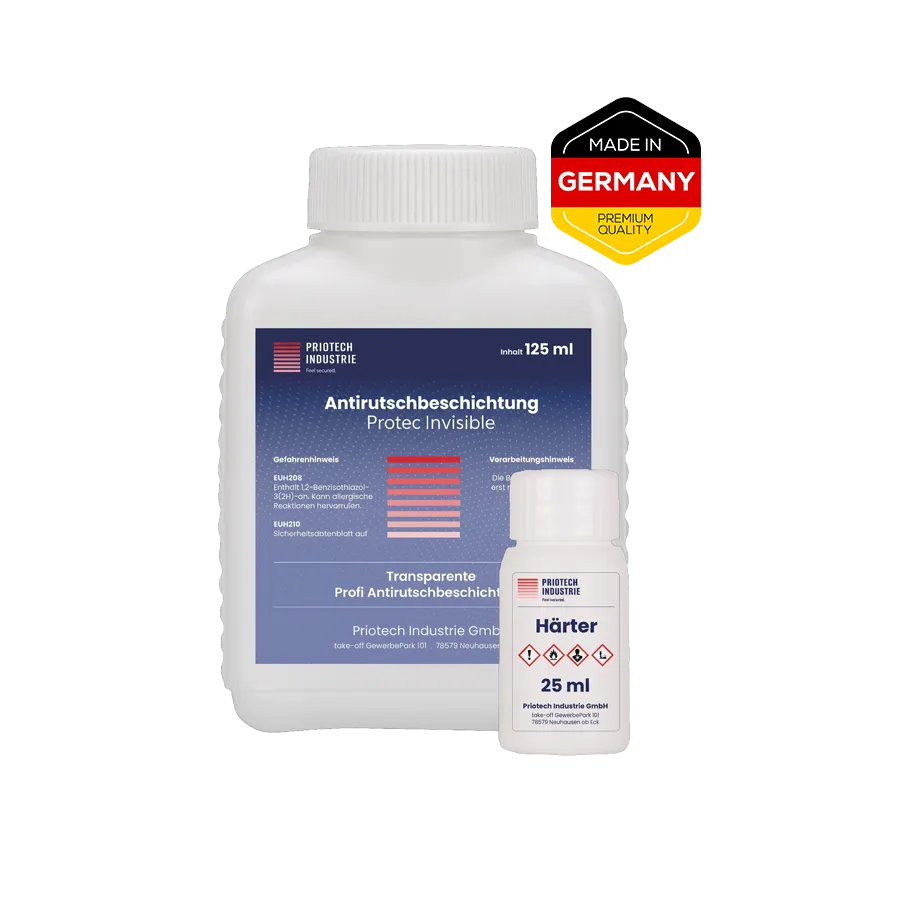
Slip resistance for tiles - The perfect anti-slip coatings

We have developed the best anti-slip coating for tiles. Nearly completely transparent once applied. Easy to apply. Exceptionally durable. Excellent adhesion. Our coatings are virtually invisible. They are easy to clean, can be applied with a roller or spray gun, and are extremely abrasion-resistant. Even frequent foot traffic, such as in commercial settings like spas, public baths, or hotels, does not affect our coatings.

How can you make tiles slip-resistant?

To prevent slipping on tiles, the following measures can be taken:

Anti-slip coatings Use special anti-slip coatings that are applied to the tiles to increase their slip resistance.

Slip-resistant tiles When purchasing, select tiles that already have a slip-resistant surface or a high slip-resistance rating.

Rubber mats or rugs Place non-slip mats in areas with a high risk of slipping, such as bathrooms or kitchens.

Anti-slip strips Apply anti-slip stickers or strips to the tiles, especially in critical areas like stairs.

Regular cleaning Keep the tiles clean and free of dirt, water, or soap residue to reduce the risk of slipping.

Water-repellent sealant Use a sealant that protects the tiles from water and moisture, thereby reducing slipping on wet surfaces.

By combining these methods, you can significantly improve the safety of your tiles and minimize the risk of slipping.

Which anti-slip coatings are suitable for tiles?

There are various anti-slip coatings available for tiles that are well-suited for the task. Here are a few options.

Water-based anti-slip coatings: These are environmentally friendly and easy to apply. They offer good slip resistance and are available in various gloss levels.

Epoxy resin coatings: These are particularly robust and durable. They offer excellent slip resistance and are ideal for high-traffic areas.

Silicone coatings: These are flexible and provide a non-slip surface that is well-suited for bathrooms and kitchens.

Anti-slip stickers: These are a simple and cost-effective solution for making tiles slip-resistant. They can be easily applied and removed when necessary.

It is important to consider the specific requirements and the area of application in order to select the most suitable anti-slip coating.

Is an anti-slip coating for tiles hygienic?

An anti-slip coating for tiles can be hygienic, provided it is selected and maintained correctly. Here are some points regarding hygiene.

Surface texture: Anti-slip coatings can have a rough surface that may attract dirt and bacteria. It is important to choose a coating that is easy to clean.

Materials: High-quality anti-slip coatings are resistant to mold and bacteria, which improves hygiene. Make sure to choose a product that is labeled as antibacterial or mold-resistant.

Care and maintenance: Regular cleaning of the coated tiles is crucial to prevent the accumulation of dirt and germs. Good hygiene also depends on proper maintenance.

Bonding and cracks: If the coating does not adhere properly or shows cracks, water can penetrate and compromise hygiene. Be sure to check the coating regularly and renew it if necessary.

Overall, an anti-slip coating can be hygienic if it is made of suitable materials and is well maintained.

How do you recognize a good anti-slip coating?

A good anti-slip coating can be identified by several features. Here are some important points you should look out for.

Slip resistance rating Pay attention to the specified slip resistance rating (e.g., R9 to R13 according to DIN 51130). The higher the value, the more slip-resistant the coating.

Material quality High-quality anti-slip coatings consist of robust, long-lasting materials that are resistant to wear and chemical influences.

Ease of application A good coating should be easy to apply, either by yourself or by professionals. Check whether clear instructions for use are provided.

Drying time Find out about the drying time of the coating. A quick drying time can make it easier to use.

Water and dirt repellent A good anti-slip coating should also be water and dirt repellent to promote hygiene and longevity.

UV resistance If the tiles are in an area with sunlight, the coating should be UV-resistant to prevent fading or embrittlement.

Durability Find out about the service life of the coating and whether it needs to be renewed regularly.

Certifications and tests Look for products that have been tested and certified by independent institutes. This gives you additional assurance regarding quality.

What makes the "Protec Invisible" anti-slip coating from Priotech Industrie particularly suitable for use on tiles?

The anti-slip coating Protec Invisible offers several properties that make it particularly suitable for use on tiles.

High slip resistance Protec Invisible achieves a high degree of slip resistance, making it ideal for areas where wetness or other sources of danger exist.

Almost invisible application Once applied, the coating is nearly transparent and leaves no visible residue, preserving the original appearance of the tiles.

Durability It is known for its resilience and provides a long-lasting solution that holds up well even under heavy use.

Easy application The coating can be applied relatively easily, allowing for a quick and straightforward application.

Water and dirt repellent It additionally offers protection against water and dirt, which facilitates the hygiene and maintenance of the tiles

UV resistance The coating is resistant to UV rays, making it ideal for use in light-filled areas without fading or wearing out over time.

Versatility It can be used on various types of tiles, including ceramic, porcelain, and natural stone, which expands its range of applications.

These features make the Protec Invisible anti-slip coating an effective and aesthetic solution for increasing slip resistance on tiles.

Use Cases

Tile slip resistance - Our anti-slip coating Protec Invisible is used in private, commercial, and industrial settings alike.

  • Nasse Fliesen in einem Bad

    Shower, bath

    Tiles in the bathroom, kitchen, and other areas of the house (e.g., in the basement)

  • Poolumrandung aus Fliesen

    Spa, wellness

    Tiles in spa, sauna, wellness, and wet areas

  • Beine in einem Pool

    Pool

    Pool surrounds, swimming pool tiles, stairs, floors, etc.

  • Antirutsch Fliesen in einer Küche

    Kitchen, storage

    Industrial kitchens, food industry, e.g., meat and fish processing

1 of 4

How must tiles be prepared for an anti-slip coating?

Preparing tiles for an anti-slip coating is crucial to ensure optimal adhesion and effectiveness. Here are the steps you should follow.

Cleaning: Clean the tiles thoroughly to remove dirt, dust, grease, and other contaminants. Use suitable cleaning agents and then rinse the tiles with clean water.

Drying: Let the tiles dry completely. This is important, as moisture can impair the adhesion of the coating.

Surface inspection: Check the tiles for cracks, chips, or other damage. These should be repaired before applying the coating.

Sanding (optional): For smooth tile surfaces, light sanding with fine-grit sandpaper or a special sanding machine can be helpful to improve the coating's adhesion. Make sure to clean the tiles again afterwards to remove sanding dust.

Masking edges: Cover edges or adjacent areas with masking tape to prevent the coating from overflowing.

Test application: You may want to perform a test application on a small, inconspicuous area to ensure that the coating delivers the desired results and no unwanted reactions occur.

By following these preparatory steps, you create the best conditions for a successful anti-slip coating on your tiles.

If you have any questions, feel free to contact our expert advisors or send us a message. 

At what temperatures should the coating be applied?

The optimal temperature for applying an anti-slip coating to tiles varies depending on the product, but generally, the following temperature conditions should be observed:

Room temperature: Ideally, the application should take place at temperatures between 15 °C and 25 °C. This ensures good adhesion and drying of the coating.

Avoidance of extreme temperatures: Avoid application in extremely high or low temperatures, as this can impair the properties of the coating. Temperatures that are too high can shorten the drying time and lead to uneven application, while temperatures that are too low can delay curing.

Avoidance of humidity: Ensure that the humidity is not too high, as this can also affect the drying time and adhesion. A relative humidity of 40-60% is ideal.

Surface temperature: Ensure that the tile surface is also within the recommended temperature range to guarantee optimal adhesion.

It is important to follow the specific instructions of the anti-slip coating manufacturer, as these should contain precise recommendations for the application temperature.

How long does it take for the anti-slip coating to dry?

The drying time of an anti-slip coating on tiles can vary depending on the product, ambient temperature, and humidity. As a general rule, however, the following applies:

Dust-dry: Most anti-slip coatings are dust-dry after about 30 minutes to 1 hour. During this phase, the surface can be touched carefully without any residue sticking to it.

Touch-dry: After about 1 to 3 hours, most coatings are touch-dry, meaning they are no longer sticky and can be walked on carefully.

Full curing: Full curing can take between 24 and 48 hours depending on the product. During this time, the coated area should not be subjected to heavy use or brought into contact with water.

It is important to observe the specific drying times and application instructions provided by the manufacturer, as these can vary from product to product.

How long does an anti-slip coating on tiles last?

The lifespan of an anti-slip coating on tiles can vary and depends on several factors, including:

Quality of the coating: High-quality anti-slip coatings are generally more durable and resistant to wear.

Frequency of use: In high-traffic areas, such as commercial kitchens or public facilities, the coating may wear out faster than in private living spaces.

Cleaning and maintenance: Regular, gentle cleaning without aggressive chemicals can extend the lifespan of the coating. Aggressive cleaning agents or mechanical cleaning can damage the coating.

Environmental conditions: Factors such as humidity, temperature, and UV radiation can also influence the durability of the coating.

In general, an anti-slip coating on tiles can last between 3 and 5 years, although some high-quality products may remain effective for longer. It is advisable to check the coating regularly and, if necessary, treat or renew it to maintain slip resistance.

How do you clean tiles that have an anti-slip coating?

Cleaning tiles with an anti-slip coating requires special care to avoid damaging the coating. Here are some tips for proper cleaning:

Regular dust and dirt removal: Sweep or vacuum the tiles regularly to remove dust, dirt, and loose particles. This prevents dirt from becoming embedded in the grooves of the anti-slip coating.

Avoidance of harsh cleaning agents: Use mild cleaning agents that are suitable for coated surfaces. Avoid harsh chemicals, abrasives, or scouring cleaning agents, as these can damage the coating.

Warm water: In many cases, warm water is sufficient to clean the tiles. Use a damp mop or a soft cloth to wipe the surfaces.

pH-neutral cleaning agents: If necessary, you can use pH-neutral cleaning agents that are specially designed for coated floors. Follow the manufacturer's instructions for dilution.

Thorough rinsing: After cleaning, the tiles should be rinsed thoroughly with clear water to remove any cleaning agent residues that could impair slip resistance.

Drying: Allow the tiles to dry well after cleaning to avoid water accumulation and associated slip hazards.

By following these cleaning guidelines, you can extend the service life of the anti-slip coating and ensure the safety of your tile surfaces.

Can an anti-slip coating be repaired retrospectively?

Yes, an anti-slip coating on tiles can in many cases be repaired retroactively. Here are some steps and considerations for doing so:

Checking the coating: First, you should check the condition of the existing coating. If there is only minor damage or wear, a repair can be considered.

Cleaning: Before repairing, it is important to clean the tiles thoroughly to remove dirt, dust, and grease. A clean surface is crucial for the new coating to adhere well.

Sanding (if necessary): In some cases, it can be helpful to lightly sand the damaged areas to improve the adhesion of the new layer.

Applying the new layer: Apply the anti-slip coating to the affected areas according to the manufacturer's instructions. Make sure to distribute the new coating evenly.

Observe drying time: Allow the new layer to dry completely according to the manufacturer's recommendations before the surface is used again.

Regular maintenance: To extend the life of the coating, it is advisable to clean the tiles regularly and monitor the condition of the coating.

It is important to note that not all coatings are the same, and the possibilities for repair may vary depending on the product and manufacturer. Therefore, it is advisable to consult the specific instructions of the manufacturer.

Frau im Callcenter

Talk to us

We are here for your request. Do you have any questions or would you like a quote for a larger quantity?

What would you like to tell us?

We will be in touch with you as soon as possible.