Accident prevention S-R-S accidents - regulations and rules

Accidents caused by tripping, slipping, or falling (so-called S-T-F accidents) are among the most common workplace accidents, with numerous negative consequences for both the individuals affected and the companies. To prevent such accidents as much as possible or to keep the risk as low as possible, legislators in various countries, as well as the European Union, have issued and published numerous regulations, recommendations, and rules. On the following pages, we provide information on all important aspects of these regulations and requirements, both national and international. Anti-slip company - regulations - here are the most important contents.

We have compiled the following information for you:
  • Overview of the current situation regarding workplace accidents
  • Assessment of the risk of slipping under operating conditions (incl. download)
  • Regulations for anti-slip measures and accident prevention in Germany
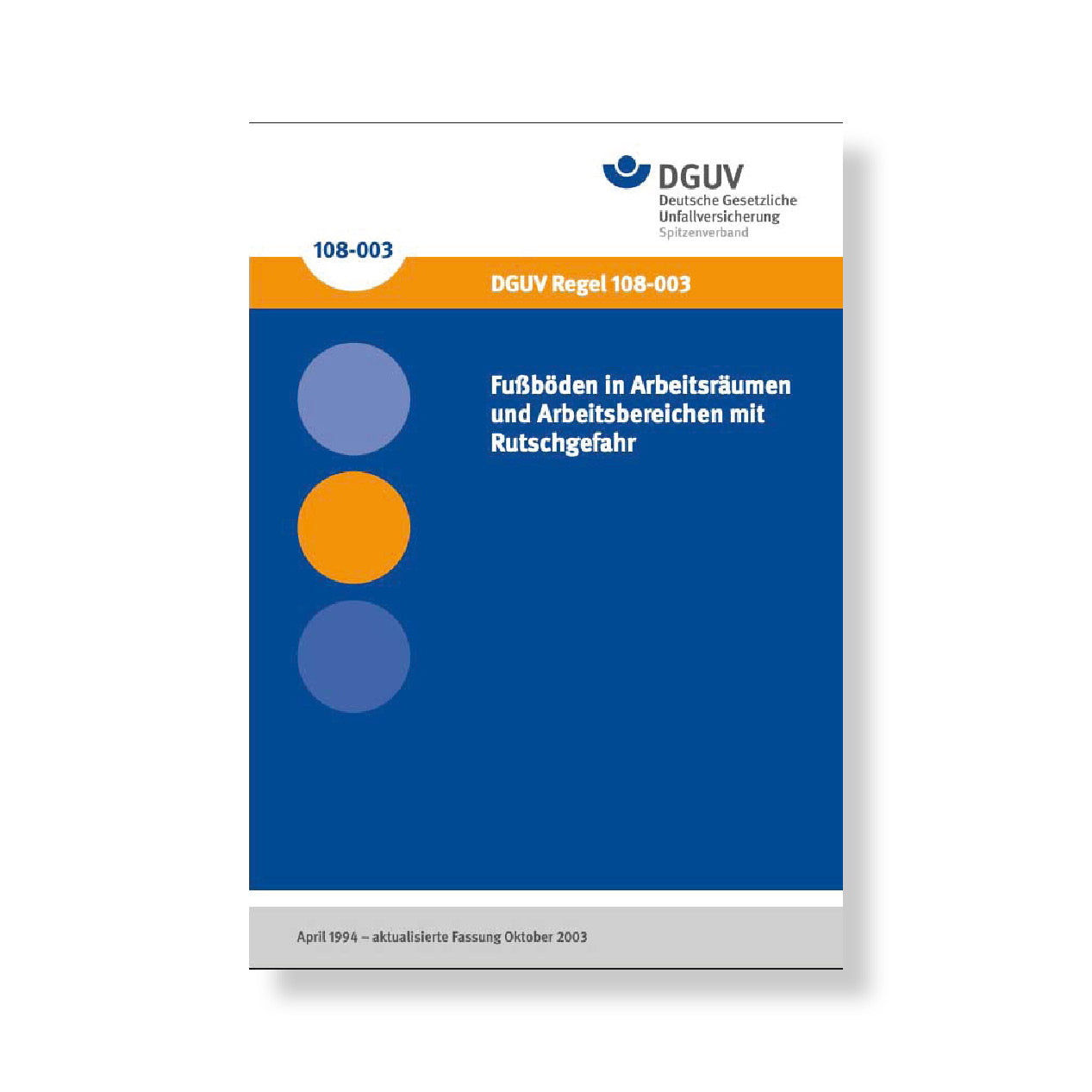
  • DGUV Rule 108-003 incl. download
  • Obligations for employers regarding protection against slip accidents (binding)
  • Difference between DGUV regulations and DGUV rules
  • International regulations and rules (EU and non-EU)
  • Example (France)
  • Measurement and measurement methods for slip resistance in Germany
  • Measurement and measurement methods internationally (EU, USA, UK)
  • Links to regulatory frameworks (laws, technical rules, BG regulations)

* This information does not constitute legal advice. Regulations and laws are subject to regular updates. We do not guarantee the accuracy or currency of the information.

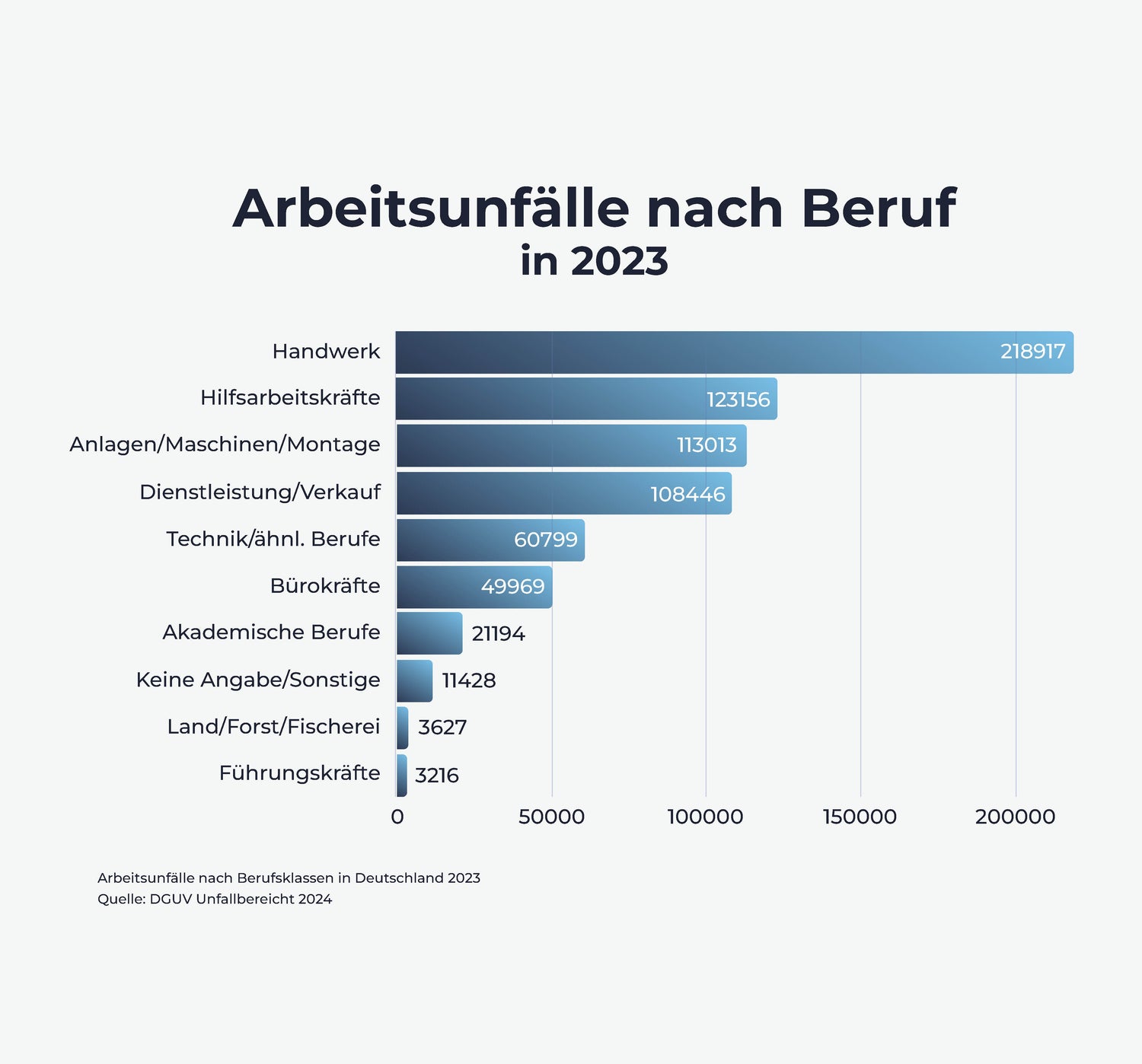
Grafik Arbeitsunfälle nach Beruf

Statistics on occupational accidents in Germany 2024

Every year, the DGUV (German Social Accident Insurance) publishes an up-to-date annual report on workplace accidents in Germany. According to the DGUV's 2024 report, so-called "S-R-S accidents" represent the second most common cause of accidents in German companies.

According to the report, 156,314 accidents in 2023 were attributable to this cause!

21.9% of all accidents are "trip, slip and fall" accidents.

In 2023, approximately 21.9% of all occupational accidents in Germany were attributable to slips, trips, and falls (STF accidents). This makes STF accidents the second most common cause of workplace accidents. The German Social Accident Insurance (DGUV) publishes annual statistics on occupational accidents, which are also broken down by cause.

Statistics and charts:

The DGUV publishes an annual report on "Accident Events," which is based on accident reports from companies. These statistics are valid because companies are required to report reportable accidents (injuries resulting in at least four days of incapacity for work). The DGUV statistics indicate that STF accidents accounted for around 21.9% of all workplace accidents in 2023. There are also charts and factsheets that specifically address STF accidents, such as the DGUV factsheet. These charts can illustrate the trend in STF accidents over the years or their share of total accidents.

Causes and consequences:

  • STF accidents are the second most common cause of accidents after internal transport.
  • Slips, trips, and falls can lead to various injuries, such as ankle and foot injuries.
  • These injuries can, in turn, lead to longer periods of absence from work.
  • Therefore, it is important to take preventive measures to avoid STF accidents.

In summary: STF accidents are a significant problem in the German workplace and account for a considerable portion of occupational accidents. The DGUV provides detailed statistics and charts on workplace accidents, including STF accidents, which can be used for prevention work.

Source: DGUV

Drei Männer mit Helmen und Warnkleidung

Assessment of slip risk under operating conditions

The Workplace Ordinance [1] requires that floors must, among other things, be designed to be slip-resistant. The Technical Rules for Workplaces, ASR A1.5/1,2 "Floors" [2] specifies this requirement and refers to the risk assessment that must be carried out by the employer. This DGUV information serves to assess the risk of slipping under operational
conditions by testing slip resistance.

Slip accidents - Further results

Unfortunately, fatal workplace accidents resulting from slips or trips still occur time and again. Some industries have a particularly high level of risk in this regard.

  • Ursachen für Arbeitsunfälle Grafik

    Causes of work-related accidents

    Structural facilities represent by far the greatest cause of workplace accidents. Many of these accidents could be avoided through improved slip protection.

  • Grafik tödliche Arbeitsunfälle

    Fatal causes of accidents

    Falls are the most common cause of death in workplace accidents. This finding underscores the immense importance of reliable protection against slipping and tripping in a particularly drastic way,

1 of 2

Anti-slip regulations for companies in Germany

The German Social Accident Insurance (DGUV) is the central organization for statutory accident insurance in Germany. Its rules and regulations, particularly those concerning the prevention of slip accidents, are designed to increase workplace safety and minimize accidents. The DGUV (German Social Accident Insurance) has regulations and guidelines for the prevention of accidents caused by slipping. These regulations relate to the design of workplaces, the selection of suitable materials, staff training, and the implementation of risk assessments.

An important point is ensuring slip-resistant surfaces in areas where there is a risk of slipping, such as in production facilities, warehouses, or on construction sites. Correct employee behavior, such as wearing appropriate footwear and following safety-related instructions, also plays a crucial role. The DGUV also provides information and practical guidance to educate employers and employees on accident prevention measures. It is recommended to consult the specific DGUV regulations and guidelines to obtain detailed information.

Deckblatt der DGUV Regel 108-003

DGUV Rule 108-003

Here you can download DGUV Rule 108-003 regarding safety against slip accidents. In this DGUV rule, you will find the precise specifications for the slip resistance class (R9 to R13) that an anti-slip coating must meet in various industries and applications.

Legal Basis

The legal basis under which companies in Germany must secure their workplaces and floors against slip accidents is clear and binding. These are not recommendations, but a legal obligation.

The central legal foundations are:

  1. The Occupational Health and Safety Act (ArbSchG):
    The ArbSchG is the fundamental legal standard for occupational health and safety in Germany. It generally obligates employers to ensure the health and safety of their employees. This includes the obligation to conduct a risk assessment. In this assessment, all workplace hazards, including the risk of slipping, must be systematically identified and appropriate protective measures derived.
  2. The Workplace Ordinance (ArbStättV):
    This ordinance specifies the requirements of the Occupational Health and Safety Act for the design of workplaces. The annex to the ArbStättV (§ 3 para. 1) contains specific requirements for floors. It requires that floors in rooms must not have any unevenness, holes, tripping hazards, or dangerous slopes. They must also be stable, slip-resistant, and non-slip.
  3. The Technical Rules for Workplaces (ASR):
    The ASR reflect the state of the art, occupational medicine, and hygiene. They are not laws, but by adhering to them, the employer can assume that they are fulfilling the requirements of the Workplace Ordinance. ASR A1.5 "Floors" is the central set of regulations for slip resistance. It describes in detail:
  4. DGUV Rule 108-003:
    The German Social Accident Insurance (DGUV) supplements state regulations with its own rules. DGUV Rule 108-003 is almost identical to ASR A1.5 and also provides a classification of work areas according to the required slip resistance classes.

Risk assessment

A risk assessment, often also referred to as a hazard assessment, is a systematic process that companies must carry out in order to identify potential workplace hazards, evaluate them, and take measures to eliminate or minimize them. In the context of preventing slip accidents, this assessment focuses specifically on the risk of slipping in all relevant work areas.

Purpose and procedure of the risk assessment

The risk assessment is a legally required instrument of occupational health and safety, anchored in the Occupational Health and Safety Act (ArbSchG). For the prevention of slip accidents, it generally follows these steps:

  1. Identify hazards: The company inspects all work areas and determines where the risk of slipping, tripping, or falling exists. This can be the case on wet, oily, smooth, or uneven floors, stairs, or ramps.
  2. Assess risk: Each identified hazard is evaluated. This involves estimating the probability of an accident and the potential consequences (ranging from a slight bruise to serious injuries).
  3. Derive and implement measures: Based on the risk assessment, appropriate protective measures are determined. This can include selecting non-slip flooring, applying special anti-slip coatings, or laying down mats.
  4. Review measures: The effectiveness of the implemented measures is regularly reviewed and adjusted if necessary.
What is taken into account in the risk assessment for slip hazards?

The assessment of slip hazards is a complex process that takes various factors into account:

  • Floor conditions: Is the floor smooth, rough, uneven, or damaged?
  • Type of contamination: What substances can get onto the floor (water, oil, grease, coolants, flour, etc.)?
  • Work processes: What activities take place on the surface (walking, standing, transporting heavy loads)?
  • Work clothing and footwear: Are employees wearing appropriate, non-slip footwear?

The risk assessment often results in the recommendation to use flooring with a specific slip resistance class (R-class) according to DIN 51130. If the existing floor does not meet this class, the company must take appropriate measures, such as installing an anti-slip coating, to ensure safety.

Preventive measures

In accordance with statutory regulations (ArbSchG, ArbStättV, ASR A1.5, etc.), companies must implement preventive measures that follow a specific hierarchical principle to ensure the safety of workplaces. The central legal requirement is the performance of a risk assessment, from which the following measures must be derived.

The common approach follows the STOP principle:

  • S - Substitution (Replacement): Hazardous substances or processes should, where possible, be replaced by less hazardous ones.
  • T - Technical measures: Hazards should be eliminated or minimized through technical solutions.
  • O - Organizational measures: Work instructions and rules of conduct are established to reduce the remaining hazards.
  • P - Personal protective measures: As a final resort, personal protective equipment is provided.

In detail, companies must implement the following preventive measures:

1. Technical measures (priority)

Technical measures are the most effective because they combat the hazard at the source.

  • Selection of the correct flooring: Companies must ensure that the flooring in the respective work areas has the required slip resistance class (R-class according to DIN 51130). For wet or oily floors, higher R-classes are mandatory.
  • Installation of anti-slip coatings: If the existing floor does not meet the requirements, companies must retrofit it by applying an anti-slip coating. This is one of the most effective measures for permanently securing floors and surfaces.
  • Maintenance and repair: Floors must be regularly checked for damage (cracks, holes) and repaired immediately to eliminate tripping hazards.
  • Drainage and water removal: In wet areas, effective drainage (e.g., through channels, drains) must be ensured so that no liquids accumulate on the floor.
2. Organizational measures

Cleaning and maintenance plans: Binding cleaning plans must be created to ensure that floors are regularly and properly cleared of dirt, oil, or other slip-promoting substances.

  • Marking of hazard zones: Areas where there is a temporarily increased risk of slipping (e.g., during cleaning) must be clearly marked with warning signs (e.g., "Caution, wet!").
  • Training of employees: Employees must be informed and trained about slip hazards in the workplace, correct conduct, and the importance of anti-slip surfaces and footwear.
3. Personal protective measures

Provision of safety shoes: Companies are obliged to provide their employees with suitable, slip-resistant safety shoes in areas with a risk of slipping. Employees, in turn, are obliged to wear these shoes.

The implementation of all these measures must be documented in the risk assessment. It serves as proof to authorities and professional associations that the company has fulfilled its duty of care.

Documentation and verification

In accordance with statutory requirements, companies must carefully document all preventive measures resulting from the risk assessment. This documentation is not only a mandatory requirement, but also serves as important proof for authorities and professional associations that the company has fulfilled its duty of care.
The documentation should include the following points:

1. Documentation of the risk assessment

This is the core of the documentation. Every risk assessment must be recorded in writing. The documentation should contain:

  • the hazards identified (e.g., risk of slipping due to wetness, oil, etc.)
  • the assessment of the risk
  • the protective measures derived therefrom (e.g., use of a special anti-slip coating)
  • the responsibilities for the implementation of the measures
  • the deadlines for the implementation of the measures
  • the date of the review and update of the risk assessment.
2. Documentation of technical measures

Product verification: It must be documented which product (e.g., an anti-slip coating with slip resistance class R13) was used. A data sheet or product description from the manufacturer confirming the slip resistance class should be attached.

  • Proof of execution: It must be recorded when and by whom the measures (e.g., the application of the anti-slip coating) were carried out.
3. Documentation of organizational measures

Operating instructions and training: The completion of training on slip hazards must be proven. This can be done through training protocols, attendance lists, or digitally documented instructions.

  • Cleaning plans: The cleaning and maintenance plan must be documented and its compliance monitored.
4. Documentation of personal protective measures

Procurement and handover: It must be proven that appropriate safety shoes with anti-slip soles were procured and made available to employees.

  • Instruction: Employees must be instructed in the use and care of personal protective equipment. This must also be documented.

Training

The DGUV emphasizes the importance of training and instruction for employees in order to raise awareness of slip hazards and promote preventive behavior.

DGUV regulations and DGUV rules - What is the difference?

  • DGUV Regulations

    • Binding nature: DGUV regulations are legally binding rules issued by the accident insurance institutions. Employers are required to comply with these regulations.
    • Content: They establish specific requirements for occupational health and safety and often relate to certain activities or industries.
    • Objective: The main objective is to ensure the health and safety of employees in the workplace.
  • DGUV Rules

    • Nature of recommendations: DGUV rules are recommendations that serve as guidelines for implementing regulations. They are not legally binding, but offer valuable advice on the practical implementation of requirements.
    • Content: They contain detailed information and examples of how regulations can be complied with and provide best practices for occupational health and safety.
    • Objective: They are intended to help companies implement regulations effectively and achieve a high level of safety.
1 of 2
Rundes Bild mit Flaggen der EU Staaten

International Regulations, Policies, and Guidelines

In European and international countries, there are binding rules and regulations for the prevention of slip accidents, which are set out in various legal provisions and standards. These regulations are frequently part of general occupational health and safety laws and directives that aim to ensure a safe working environment.

EU guidelines for the prevention of slipping accidents

At the European level, there is no single directive that deals exclusively with the prevention of slip accidents. Instead, basic protective measures are embedded in an overarching legal framework that obliges member states to enact and implement national laws.

The most important foundation is the EC Framework Directive on Health and Safety at Work (Directive 89/391/EEC).

The EC Framework Directive on Health and Safety at Work (89/391/EEC)

This directive establishes the fundamental principles for improving safety and health at work throughout the European Union. It serves as the "superstructure" for all national occupational health and safety laws (such as the German Occupational Health and Safety Act).

Important principles that also relate to slip resistance are:

  • Duty to conduct a risk assessment: The directive obliges employers to assess and document all risks to safety and health in the workplace. This includes identifying hazards that could lead to slipping, tripping, and falling accidents.
  • Principle of prevention: Employers must combat risks at the source, i.e., act preventively. The directive establishes a hierarchy of preventive measures:
  • Duty to provide information and training: Employers are obliged to inform employees about all workplace hazards and to provide them with appropriate instruction.
Specification through further directives and national laws

The framework directive is supplemented by more specific individual directives. For example, the Workplace Directive (Directive 89/654/EEC) requires member states to ensure that workplaces meet safety requirements. This includes the stipulation that floors must be stable, even, free of dangerous holes or slopes, and not slippery.

These EU directives are then transposed into national law by the member states. In Germany, this is done through laws such as the Occupational Health and Safety Act (ArbSchG), the Workplace Ordinance (ArbStättV), and the Technical Rules for Workplaces (ASR) such as ASR A1.5 "Floors". These national regulations make the EU requirements concrete and provide detailed instructions on the selection of the correct floor coverings and the implementation of protective measures.

Frankreich Flagge

Example France

In France, there are several regulations and provisions for preventing slip accidents, which focus on workplace safety. Here are some of the most important aspects:

  • Labor Code

    The French Labor Code contains provisions that obligate employers to ensure the safety and health of their employees. This includes conducting risk assessments to identify and minimize risks such as slips and falls.

  • Occupational safety guidelines

    The French General Directorate for Labour (Direction Générale du Travail, DGT) issues recommendations and guidelines that include specific measures to prevent slip accidents. These guidelines emphasize the need to use slip-resistant materials and to offer appropriate training for employees.

  • Norms and standards

    In France, European standards (such as EN 13893 and EN 51130) are recognized and implemented for the assessment of the slip resistance of floor coverings. These standards specify how slip resistance is to be tested and evaluated.

  • Employer obligations

    Employers are required to take appropriate measures to minimize the risk of slipping. This includes selecting slip-resistant materials, properly maintaining surfaces, and providing safety training for employees.

1 of 4

Measurement of slip resistance

In different countries, slip resistance is measured in various ways. What the methods have in common is that they are standardized and comply with a benchmark that allows for product comparability. The regulations and rules of different countries regarding protection against slip-trip-fall accidents refer to the nationally or internationally valid measurement procedures. For example, in Germany, DGUV rules are formulated according to the classifications valid in Germany - from R9 to R13. The process for determining slip resistance classes in Germany is strictly regulated and recorded in the DIN standard DIN 51130. Anti-slip products can undergo this procedure and receive certification upon passing the tests.

Our products Protec R13 One and Protec R13 Two are certified according to DIN 51130 for the highest slip resistance class, R13.

Slip resistance measurement methods - National and international

  • Deutschland Flagge

    DIN 51130 (Germany)

    This standard describes the procedure for determining the slip resistance of floor coverings. It is measured using an inclination angle test, in which a test surface is coated with a special sliding plate and a lubricant. The results are classified into slip resistance classes (e.g., R9 to R13).

    • Application: This standard is particularly relevant for commercial and industrial use where slip resistance is critical, such as in workshops, warehouses, or production facilities.
    • Procedure: A sliding plate is placed on the surface being tested while the inclination angle of the surface is gradually increased. The inclination angle at which the plate begins to slide is measured and categorized into slip resistance classes: R9 (lowest slip resistance) to R13 (highest slip resistance).
  • Europa Flagge

    EN 13893 (Europe)

    This standard specifies a method for determining the slip resistance of floor coverings in interior spaces. Sliding friction is measured using a special test device, and the slip resistance is indicated by numerical values from 0 to 1.

    • Application: This standard is frequently used for indoor floor coverings, such as those in offices, schools, and hospitals.
    • Procedure: A specific device is used to measure sliding friction under controlled conditions. The coefficient of friction is determined and expressed as a value between 0 and 1. A higher value indicates better slip resistance.
  • USA Flagge

    ASTM C1028 (USA)

    This method is used to determine the slip resistance of floor coverings. A slider is used to measure friction, and the results are expressed as a value describing the slip resistance.

    • Application: This method is widely used in the USA for flooring and materials used in public and commercial buildings.
    • Procedure: A slider is pulled across the surface, and the force required to determine the sliding friction is measured. The value determined in this process indicates the slip resistance and is often expressed on a numerical scale.
  • United Kingdom Flagge

    Pendulum test (e.g. BS 7976, UK)

    This method uses a pendulum device that swings across the surface of the floor covering. Slip resistance is measured by the angle at which the pendulum begins to slide and is expressed in a slip resistance class.

    • Application: This method is frequently used in Great Britain and other countries for the evaluation of floor coverings in public areas.
    • Procedure: In this test, a pendulum with a special sliding surface is swung across the surface being tested. The angle at which the pendulum begins to slide is measured and classified into slip resistance ratings.
1 of 4